Friday, March 7, 2014

Italian Renaissance


The Period:


As we had learned in class, the Renaissance is a time of "revival", new ideas and points of view were being spread across Europe. Most relate-able to our discipline however, was the new focus towards design; focusing less on the construction of grand churches, and more of a focus on residential dwellings.


Starting in Florence and Italy, the Renaissance began to really flourish with the help of some brilliant minds.

Martin Luther for example, challenged the Roman Catholic church and thus created a new form of thinking. People began to recognize the faults of the church and a newer focus on the gospel began.
Martin Luther

Humanism, or a "focus on critical thinking" began to really take prevalence. 

Earth changing inventions such as the Printing Press were being created, starting a booming spread of knowledge among people of the time.

Johannes Gutenberg, Inventor of the Printing Press


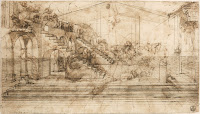
Thinkers, such as Brunelleschi and Da Vinci played a vital role in the study and practice of architecture and design.


Brunelleschi, the discoverer of perspective drawing and brilliant architect.


Da Vinci, Known for beign somewhat a mast in many trades, "The Renaissance Man".
Known for his skilled work as a painter, sculptor, architect, musician, mathmetician, engineer, inventor, anatomist, geologist, cartographer, botanist, and writer.  


The Now


The Americas

The Olmecs:

Living in the south central lowlands of modern Mexico, the Olmec people are considered the first major civilization to populate the region. Known for their Colossal Head Statues, Mesoamerican Ballgame, and bloodletting rituals, The Olmec nation laid the ground work for many civilizations to come


The Heads


Dating as far back as 900 BC, the Olmec Colossal heads are a remarkable example of this periods resourcefulness and audacity. Weighing in anywhere from 6 to 50 tons, these basalt boulders rest relatively unmarked, if not moved from their original location.

 
Spread across San Lorenzo, La Venta, and other Olmec sights, a total of 17 heads have been discovered, with many fragments and the possibility of more to be found.

All examples that have been found depict flat nosed, fleshy cheeked men that were most  likely rulers at some point; a portrait to their recently deceased leader.

The most interesting thing however is that the backs of all of the heads are flat, most likely to be placed against a wall at some point.


The Game:


The Olmecs are accredited with being the creators of the ancient ball game that can be seen throughout all of the Mesoamerican civilizations.

Their are no records to detail the exact rules of the game, however, it is believed that the primary goal was to keep the ball in play.

The most common portrayal of the game involves the players bouncing the ball with their hips, however, use of rackets and other body parts in some versions has been seen before.


The courts, although differing greatly in shape, are all masonry structures; created out of stone with large surfaces for the ball to bounce off of.

Over 1300 Mesoamerican ball courts have been discovered to date.


The Now:


Sunday, February 23, 2014

Romanesque v. Gothic Architechture


Here is a short video about some of the primary differences about the Romanesque and Gothic architectural styles.      Take a look if you are interested and let me know what you think.

The guy talks in a British accent, so that's fun.

Gothic

The Gargoyle


Originating during the Gothic period, the Gargoyle is a primary common feature among buildings from the period.

An important note however is that a true "gargoyle" from this period serves a greater function over its ornamental qualities.

Roughly translated in English to mean "Throat or Gullet" the gargoyle serves as a spout, a pathway for water to drain from the building. Although highly artistic, their main purpose is in fact function over form.


Chimera

Chimera however, is the name for a gargoyle like figure that is strictly ornamental; used to ward off evil spirits and protect the buildings that they guard.


Ribbed Vault

Another primary feature that can be seen among buildings from the Gothic Period would be the Ribbed Vault. A variation of the barrel vault, the Ribbed Vault was characterized by its beam like structures, or "ribs" that create a web like pattern overhead. 


Believed to create a sense of weightlessness,drawing the eyes upward, the Ribbed vaults help to place the Gothic cathedrals in a higher state of holy; invoking a sense of a heavenly presence. A great improvement from the strong, heavy, grounded Romanesque arches.


The Now:


Islamic Style

Islamic Design


The Taj Mahal

Standing at a surprisingly minimal 240 ft, the central dome of the Taj Mahal towers over its vast memorial complex. Constructed by Ustad Ahmad Lahauri, "the Taj" - as it is reffered - was built as a memorial tomb for his third wife Mumtaz Mahal. Built to be the grandest construction ever made by man, the Taj Mahal seems a suitable name; directly translating to the phrase "Crown of Palaces.

File:Taj Mahal 2012.jpg

The Construction:

The Taj was mainly adorned with white marble, however, it was in fact built with many materials from all over India and Asia. The erecting of the structure was such a large undertaking in fact, that the scaffolding used during its construction was practically a monument all its own. A large brick structure that foreman suspected would take years to dismantle after the Taj's completion.


Nearly 1000 elephants were used to carry building materials to the site from across India. Equally the construction required a nearly 20,000 man workforce. Sculptors, Inlayers, Stone Cutters, and Engravers from across India were given the task of erecting this massive, and beautiful structure.


Modern Day: