Sunday, February 2, 2014

Classical Civilization: Rome

Classical Civilization Rome:

The Road


The greatest thing that stuck out to me about this lesson is how powerful the Roman Empire really was. More interestingly however, is how the Romans used their skills in road making to their advantage as a powerful, mobile force.

The expanse of the Romans system of roads was impressive enough without being coupled with their amazing intricacy. Stone paved and designed for water drainage, these roads were designed to last and take great abuse from the armies of people that traveled on them. Without a doubt one of the most important aspects of Roman power and influence of the area during this time period.


Roman Influence Today:

Bathroom designed in a Roman Style

The Capital Building

Classical Civilization: Greece

Classical Civilization: Greece


Throughout history there are amazing examples of our innate ability to create. We as humans are continually pushing the boundaries of what is possible. From what we have learned in class, ancient Greece has left fairly large examples of this fact.

The classical orders are a great representation of the growth of power and sophistication in ancient Grecian society. Representing both power, strength, and stature; along with a growing sophistication. Each order becoming more and more intricate as they are pulled from the old ways into the new.

The Doric Order: The largest, and least stylized order. Although very impressive for its size, it does not very well demonstrate the sophistication of the other two orders that we spoke about in class.


The Iconic Order: Here is where you begin to see a transition towards a more stylized topper, and in most cases, a narrower column along with it.


The Corinthian Order:  Finally, the Corinthian Order is where you begin to see a great, almost exponential leap in the complexity of the classical orders. Something that I think really helps represent the growth and change that was found in Greece during this time period.


The Now:


Wednesday, January 29, 2014

Ancient Civilization: Egypt

Ancient Civilization: Egypt

The Facts:

Ancient Egypt can easily be considered the first great city. Around 4,000 B.C. with basic human needs secured along the waters of the Nile River, Ancient Egyptians could focus greater attention on developing other aspects of their daily lives. With more intricate ideas and inventions coming into the foreground, Ancient Egypt places itself as one of the first great cities, creating a greater interest in things beyond basic human needs; and therein starting a global shift towards the lavish and the luxurious.

The Thoughts:

Throughout the lecture and my own personal research, it is undeniable that Egypt was the launching point for much of our way of life; not only in style and design, but in our lavish thinking and our desire for the bigger and the better. However, I have found that my greatest interest in Ancient Egypt, lies not in its similarities with modern culture, but rather in its differences. Differences that can be seen throughout history, and throughout cultures since the dawn of man. There are obvious differences in structure building, dress, and customs; more deeply however, the way different cultures determine "What is power" "What is attractive" "What is comfortable".

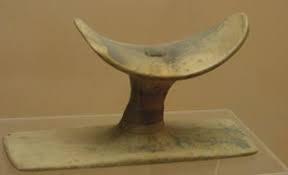
A great example of this very thought can be found in their furniture style. Interesting angles and curves, designated elevated head rests, stiff, firm materials. "Comfort" is not the first word that comes to mind when looking through images of Ancient Egyptian furniture. More importantly however is that these items were considered luxurious!? Now, I am not faulting the Ancient Egyptians for not having access to electric blankets and memory foam mattresses, I simply am fascinated with these pieces, and even more enamored with the fact that these pieces were once considered comfortable and luxurious. A fantastic representation of ever changing ideas and values.


The Now: